GTM & RevOps
What Is RevOps? Revenue Operations, Explained
What is RevOps? Revenue operations aligns marketing, sales and success around one dataset. What RevOps teams do, RevOps vs sales ops, tools, and AI's role.
By the gtmind teamPublished 9 min read
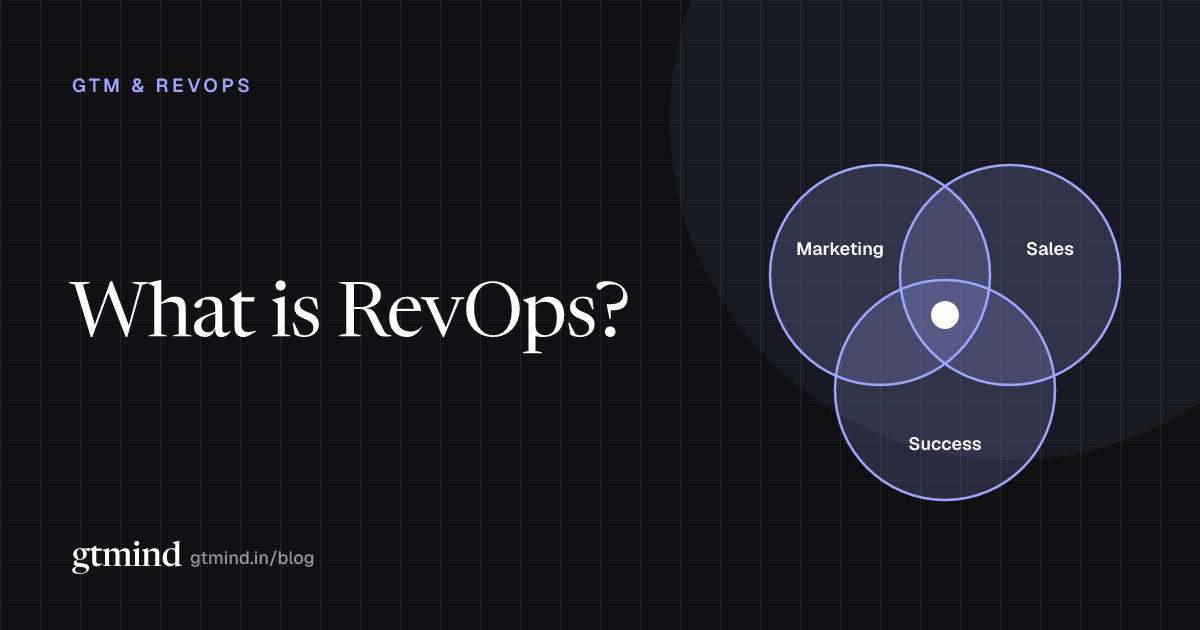
RevOps (revenue operations) is the function that runs marketing, sales and customer success off one process, one set of definitions and one dataset. Instead of each team keeping its own tools and its own version of the truth, RevOps owns the systems, data and rules that connect them, so revenue becomes predictable and measurable end to end.
Key takeaways
- RevOps exists because each revenue team sees only part of the customer journey. Its job is to join those parts.
- The usual framework has four pillars: process, enablement, systems, and data.
- RevOps is broader than sales ops. It spans the full lifecycle, from first touch to renewal.
- Reporting lines vary by company size. Operations is most common, and Sales (the CRO) grows at enterprise scale.
- In 2026, RevOps is shifting from building dashboards to supervising AI agents and the GTM engineers who build them.
What is RevOps, in one paragraph?
What is RevOps in practice? It is the team that makes sure a lead generated by marketing is routed to the right rep, that the deal is tracked the same way from first touch to renewal, and that the CEO, the CFO and the head of sales all read the same number on Monday. RevOps doesn't sell or run campaigns. It builds and maintains the machine that selling and marketing run on.
The idea went mainstream quickly. In 2021, Gartner predicted that 75% of the highest-growth companies would deploy a RevOps model by 2025. Whether or not that exact figure landed, RevOps is now a standard team in B2B software companies of almost any size.
What problems does RevOps solve?
Most revenue problems aren't effort problems. They are gaps between teams, and specifically between the systems those teams use. We call it "three tools, three truths":
| Source | What it knows | What it misses |
|---|---|---|
| Search Console | The query that brought a buyer in | The deal it became |
| Your CRM | The deal, its value, its stage | The page that started it |
| Your content team | The publishing calendar | Which article moved revenue |
Each team is right about its own slice. Nobody can answer the question the board actually asks: which activity produced revenue, and what should we do more of?
The symptoms are familiar:
- Leaky handoffs. Marketing qualified leads sit untouched because routing rules broke or nobody owns them.
- Reports that disagree. Marketing counts pipeline one way, sales another, and finance a third.
- Forecasts nobody trusts. Stages mean different things to different reps.
- Bad data. In the RevOps Co-op 2025 State of RevOps survey, 99% of respondents said they struggle with technical data issues such as duplicate records and orphaned leads.
- Blind spots on attribution. Nobody can say which campaign, channel or page produced closed-won revenue.
RevOps solves these by owning the shared layer: common definitions, connected systems, and one dataset that every team reports from.
The RevOps framework: 4 pillars
Most RevOps frameworks break the work into four pillars. The names vary, but the jobs are consistent.
1. Process
The rules of the revenue engine: lifecycle stages, lead scoring and routing, handoff SLAs between marketing, sales and success, deal stage definitions, and renewal workflows. Good process is written down, agreed across teams, and enforced by the systems rather than by reminders.
2. Enablement
Making sure people can follow the process. That covers onboarding, playbooks, CRM training, and the content reps need at each stage. In smaller companies, RevOps often owns enablement directly. In larger ones, a separate enablement team works from RevOps' process definitions.
3. Systems
The tech stack: CRM, marketing automation, sales engagement, billing, CPQ, customer success tooling, and the integrations between them. RevOps owns the architecture, meaning which tool is the system of record for which object, and how data flows between them.
4. Data
Definitions, data quality, reporting, forecasting and attribution. This is the pillar that most often breaks. A 2025 survey by Revenue Wizards of 180 RevOps professionals in 28 countries found five times as many respondents rated their data quality as poor than as excellent.
RevOps vs Sales Ops vs Marketing Ops vs GTM engineering
These roles overlap, and in a small company one person may do all of them. The difference is scope and output.
| RevOps | Sales Ops | Marketing Ops | GTM engineering | |
|---|---|---|---|---|
| Scope | Full revenue lifecycle | Sales team | Marketing team | Automated GTM systems |
| Core question | Is the revenue engine working? | Are reps productive? | Are campaigns tracked and routed? | How do we automate this? |
| Owns | Process, definitions, forecast | Territories, quotas, CRM hygiene | Martech, lead scoring, campaign data | Workflows, integrations, agents |
| Typical tools | CRM, BI, forecasting | CRM, CPQ | Marketing automation, analytics | Clay, n8n, SQL, APIs, LLMs |
| Measured by | Forecast accuracy, efficiency | Quota attainment | MQL quality, cost per lead | Pipeline created, hours saved |
RevOps vs sales ops is the comparison people ask about most. Sales ops is usually one part of RevOps. When a company "moves to RevOps," it typically merges sales ops, marketing ops and customer success ops under one leader with one set of definitions.
RevOps vs GTM engineering is the newer question. RevOps decides what the process should be and how it is measured. A GTM engineer builds the automated systems that run inside it: enrichment, routing, signal-based plays, and AI agents. Many GTM engineers come out of RevOps. For the full picture of that role, read what a GTM engineer does.
Who does RevOps report to?
There is no single answer, and the data shows it depends on company size.
Pave analyzed 746 companies with dedicated RevOps teams and found:
- Operations is the most common reporting line at most stages, from 22% to 40% depending on company size. It peaks at 40% for companies with 501–1,000 employees.
- Finance has its biggest share at small companies: 20% of RevOps teams at 51–100 employees report to Finance.
- Sales grows with scale and reaches 33% at companies with more than 3,000 employees, largely because the CRO role becomes common at that size.
The Revenue Wizards survey found 38% of RevOps professionals report to a CRO.
The practical rule: RevOps works best when it reports to someone who owns the whole revenue number, such as a CRO, COO or CEO. If it reports to the head of one team, it tends to become that team's ops function.
RevOps team structure by company stage
| Stage | Typical setup | Focus |
|---|---|---|
| Seed to Series A | One person, often part-time or a founder | CRM setup, basic routing, pipeline report |
| Series B | 1–3 people, first dedicated RevOps hire | Definitions, forecast, stack consolidation |
| Growth | 4–10 people, split into sales, marketing and CS ops, plus analytics | Attribution, capacity planning, comp plans |
| Enterprise | Large team with systems, analytics, enablement and deal desk | Governance, planning cycles, global processes |
Solo RevOps is common even at larger companies. Revenue Wizards found 23% of respondents are the only RevOps person in their company, some at firms with more than 1,000 employees.
RevOps metrics that matter
A RevOps team is judged on whether the revenue engine is efficient and predictable. These are the metrics most teams track, grouped from leading to lagging:
- Funnel health: lead-to-opportunity conversion, speed to lead, stage conversion rates, pipeline coverage
- Sales efficiency: win rate, sales cycle length, average deal size, quota attainment
- Unit economics: customer acquisition cost (CAC), CAC payback period, LTV to CAC ratio
- Retention: gross and net revenue retention, churn, expansion revenue
- Predictability: forecast accuracy against actuals
The metric most teams can't calculate well is source-to-revenue attribution: which channel, campaign or page produced the revenue. It needs marketing, web and CRM data joined, which is the hardest data job in RevOps. For the measurement side of that problem, see our guides to marketing attribution software and SEO KPIs that connect to revenue.
The RevOps tools stack, by layer
Think about revops tools in layers rather than a shopping list. Revenue Wizards found the average RevOps stack has 11 tools, so the risk is usually too many, not too few.
| Layer | Job | Examples |
|---|---|---|
| CRM (system of record) | Accounts, contacts, deals | Salesforce, HubSpot, Pipedrive |
| Marketing automation | Capture, score and nurture leads | HubSpot, Marketo |
| Sales engagement | Sequences, calls, activity capture | Outreach, Salesloft, Apollo |
| Conversation and revenue intelligence | Call recording, deal risk | Gong, Clari |
| Enrichment and data | Fill and clean records | Clay, ZoomInfo, Apollo |
| Integration and automation | Move data between tools | n8n, Make, Zapier |
| Warehouse and BI | Join sources, report | BigQuery, Snowflake, Looker |
| Search and web analytics | How buyers find and use the site | Google Search Console, GA4 |
Revenue operations software is a broad label. Some vendors sell a "RevOps platform" that covers forecasting and pipeline inspection. Others mean the whole stack above. When you evaluate one, ask which layer it replaces and which system stays the source of truth.
A common gap: search and web analytics sit with marketing and never reach the RevOps data model. That's why so many teams can report pipeline by campaign but not by the page or query that started the deal.
AI RevOps: from dashboards to agents
For most of its history, RevOps produced dashboards. Someone read the dashboard, decided what to do, and asked another team to do it. The loop took weeks.
AI is changing that in three ways.
1. Analysis gets automated
Instead of building a report and waiting for someone to notice a drop, an agent watches the metrics and explains changes as they happen: conversion fell on this page after Tuesday's deploy, or this segment's win rate dropped after a pricing change. Adoption is still early. Revenue Wizards found that 75% of RevOps professionals had never used AI for reporting.
2. Execution moves into the system
Agents can now do the work that used to be tickets: update CRM fields from call notes, enrich and route new leads, refresh a decaying web page, push a segment of high-intent accounts to sales. The RevOps role shifts from doing and assigning work to defining what agents may do and checking what they did.
3. Guardrails become part of the job
Once software can write to the CRM or the website, governance matters. Sensible defaults:
- Read-only by default. An agent reads data until someone explicitly grants write access for a specific job.
- Reversible changes. Every edit is logged as a revision you can roll back.
- Scoped permissions. Each agent gets only the access its job needs.
- Data isolation. Your records build your model only and are never pooled with other customers' data.
These are the principles gtmind is built on. It joins Search Console, GA4, your CRM and your published pages into one model, ranks each finding by expected revenue using your own closed-won deals, and runs agents only for the jobs you switch on. You can see how the loop works and which sources it connects. It isn't a CRM, a forecasting tool or a replacement for a RevOps team. It is the joined data layer and the agents on top.
An illustrative example of the kind of play this surfaces: a comparison page against a main competitor sits on page two of Google, but it appears early in the journey of several closed-won deals. Traffic reports would rank it low. A revenue-weighted model ranks it first.
How to build RevOps from scratch
If you're setting up RevOps for the first time, the order matters more than the tools:
- Write the definitions. Lifecycle stages, what counts as a qualified lead, what each deal stage means. Get marketing, sales and success to sign off.
- Pick one system of record for each object, usually the CRM for accounts, contacts and deals.
- Fix routing and handoffs so no lead or customer waits without an owner.
- Build one funnel report that every team accepts, from first touch to closed-won.
- Connect the missing sources, especially web and search data, so the funnel starts where buyers actually start.
- Automate the repetitive work, then add agents with clear guardrails.
RevOps pay: what the role earns
Revenue operations pay is solid and rises quickly with scope. Figures as of September 2026:
| Market | Source | Figure |
|---|---|---|
| US | Levels.fyi, revenue operations | Median total comp $175,200 (119 submissions); 25th–75th percentile $120,000–$267,000 |
| US | Salary.com, revenue operations manager | Average $124,557; typical range $111,596–$134,357 |
| India | Levels.fyi, revenue operations in India | Median total comp ₹21,55,102 (11 submissions) |
The gap between sources reflects what they measure. Levels.fyi counts total compensation, including equity and bonus, and skews toward tech companies. Salary.com reports base pay for a single manager-level title.
The short version
RevOps is the team that makes marketing, sales and customer success work as one revenue engine. The four pillars haven't changed: process, enablement, systems and data. What has changed in 2026 is how the work gets done. Dashboards are giving way to agents, and GTM engineers increasingly build the automated systems that RevOps defines.
The teams that get the most out of this shift are the ones that fix the data layer first. Until search, web and CRM data sit in one model, every agent and every dashboard is working from a partial truth.
Frequently asked questions
What is the purpose of RevOps?
The purpose of RevOps is to make revenue predictable. It does that by giving marketing, sales and customer success one process, one set of definitions and one dataset, so handoffs don't leak leads, reports agree with each other, and leaders can see where revenue actually comes from and where it stalls across the full customer lifecycle.
What is the main difference between RevOps and sales ops?
Sales ops supports the sales team: territories, quotas, CRM hygiene and rep productivity. RevOps covers the whole revenue lifecycle, from the first marketing touch through renewal and expansion, across marketing, sales and customer success. Sales ops is often one part of a RevOps team. The key difference is scope, and with it, who RevOps answers to.
How much does RevOps pay?
In the US, Levels.fyi shows a median total compensation of $175,200 for revenue operations roles across 119 submissions, while Salary.com puts the average revenue operations manager salary at $124,557 as of September 2026. In India, Levels.fyi shows a median of about 21.5 lakh rupees on a small sample. Pay rises with scope and seniority.
Who does RevOps usually report to?
It depends on company size. Pave's data on 746 companies with RevOps teams found Operations is the most common reporting line at most stages, Finance's share peaks at small companies, and Sales, usually a CRO, reaches 33% at companies with more than 3,000 employees. Revenue Wizards' survey found 38% report to a CRO.
What problems does RevOps solve?
RevOps fixes the problems that appear when each revenue team runs its own tools and definitions: leads that fall between marketing and sales, reports that disagree, forecasts nobody trusts, duplicate and missing CRM data, and no clear view of which campaigns, pages or channels produce closed revenue. It replaces several partial truths with one shared model.
How do I get into RevOps?
Most people move in from sales ops, marketing ops, sales, customer success or finance. Get fluent in one CRM's data model, learn SQL and a BI tool, and own a cross-team problem such as lead routing, a forecast model or a funnel report that marketing and sales both accept. Being able to show a fixed process with a measured result matters more than certificates.
Keep reading

GTM & RevOps
What Is a GTM Engineer? The Role, Skills, Stack and Salary
GTM engineers build the systems that turn buying signals into pipeline. Here is the role, the skills, the 2026 stack, real US and India pay data, and the inbound half most guides skip.
11 min read

Revenue measurement
The Best Marketing Attribution Software for B2B Teams in 2026
A neutral, B2B-first comparison of 10 attribution tools, with verified prices, who each one is for, and the organic-to-deal gap most of them leave open.
13 min read

Revenue measurement
12 SEO KPIs That Actually Tie to Revenue
Most SEO KPI lists are flat. This one is a ladder: 12 metrics from impressions to closed-won, each with a formula, a data source, a target and a dashboard layout to report them.
9 min read