Revenue measurement
The Best Marketing Attribution Software for B2B Teams in 2026
Marketing attribution software for B2B, compared honestly: HockeyStack, Dreamdata, Ruler, Cometly, Factors.ai, HubSpot, GA4 and more, with 2026 prices.
By the gtmind teamPublished 13 min read
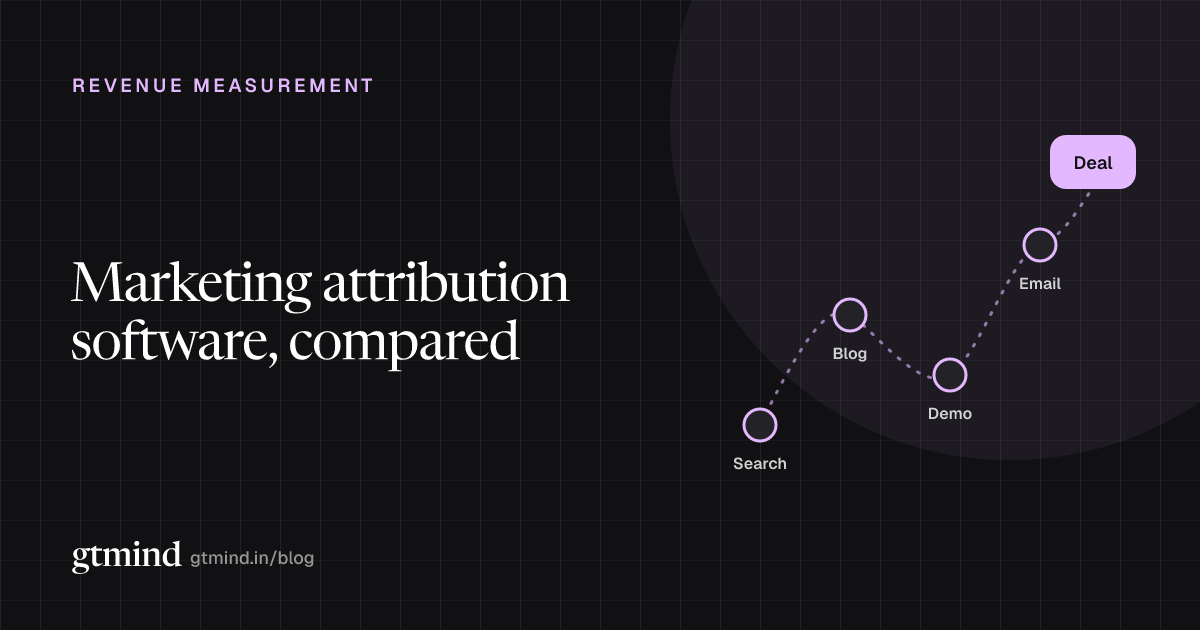
Marketing attribution software connects the touchpoints a buyer has with your company, such as ads, emails, website visits and sales calls, to the pipeline and revenue they eventually produce. It then assigns credit to each channel using a model. For B2B teams, the best tools are the ones that reach all the way to closed-won deals in your CRM.
Key takeaways
- Most marketing attribution software was built around paid media. It is excellent at crediting Meta, Google Ads and LinkedIn clicks, and much weaker at organic search.
- For B2B, CRM depth matters more than model choice. A tool that cannot see opportunities and closed-won revenue is measuring leads, not money.
- HockeyStack, Dreamdata and HubSpot Enterprise fit sales-led B2B. Ruler fits offline lead-gen. Cometly and Factors.ai lean paid and ABM. Northbeam and Hyros are ad-first tools.
- Organic search is usually one undifferentiated bucket in attribution reports, because the search query never reaches your analytics. Closing that gap needs Search Console data joined to the CRM.
- gtmind is not a classic multi-touch attribution tool. It joins Search Console, GA4 and your CRM to price organic and content work against real deals.
What marketing attribution software does (and why it undercounts SEO)
Every attribution platform does three jobs. It collects touchpoints (a tracking script on your site, ad platform connectors, email and CRM activity). It stitches them to a person or account, usually when someone fills in a form. And it distributes credit from a conversion, deal or revenue number back across those touchpoints.
The first job is where organic search gets lost. When a buyer clicks a paid ad, the click carries campaign, ad group and often keyword parameters. When the same buyer clicks an organic Google result, your site learns only that the visit came from Google organic. The query they typed is not passed along.
So in almost every attribution report, SEO shows up as a single line called "Organic Search." You can see that organic influenced a deal, but not whether it was your pricing comparison page, a glossary post or a branded search from someone who already heard your podcast. Paid channels get keyword-level credit. Organic gets a lump.
The query data exists, but it lives in Google Search Console, where it is aggregated by query and page rather than by visitor. Google also withholds rare queries entirely; its own deep dive on Search Console data explains that queries not issued by more than a few dozen users over two to three months are anonymized. No attribution tool can stitch that to a contact on its own.
That is why teams with meaningful organic pipeline often feel their attribution platform "undervalues SEO." It is not bias. It is missing data.
Attribution models in 90 seconds
An attribution model is the rule that decides how much credit each touchpoint gets. HubSpot's attribution documentation is a good plain-language reference for the common ones:
| Model | How credit is split | Good for |
|---|---|---|
| First touch | 100% to the first interaction | Judging what creates awareness |
| Last touch | 100% to the final interaction | Judging what closes |
| Linear | Equal share to every touch | A neutral starting view |
| Time decay | More credit to recent touches | Short, promotion-driven cycles |
| U-shaped | 40% first, 40% lead creation, 20% the rest | Lead-gen funnels |
| W-shaped | 30% each to first touch, lead and deal creation | Sales-led B2B |
| Data-driven | Learned from converting and non-converting paths | High-volume journeys |
Two practical notes. First, Google Analytics 4 removed most rule-based models: first click, linear, time decay and position-based were retired in November 2023, leaving data-driven and two last-click options. Second, data-driven attribution modeling needs volume. A B2B company closing 20 deals a quarter does not have enough paths for an algorithm to learn much, which is why rule-based W-shaped models remain popular in sales-led teams.
Whatever model you pick, remember it only redistributes the touches the tool can see. A perfect model on incomplete data is still incomplete.
How we evaluated these tools
Every page ranking for "best marketing attribution software" today is written by a vendor, and most put themselves first. We are also a vendor (gtmind), so we left ourselves out of the ranking and wrote a separate section on where we fit.
We scored each tool on five things that matter for B2B:
- B2B fit. Does it model accounts, opportunities and long cycles, or is it built around ecommerce orders and ROAS?
- CRM depth. Does it read deal stages and closed-won revenue from HubSpot or Salesforce, or only form fills?
- Organic coverage. Does organic search get anything better than a single channel line?
- Offline deals. Can it credit revenue that closes on a call, in a contract or weeks after the last web visit?
- Price transparency. Is there a public price, and how does it scale?
Positioning and pricing were checked on each vendor's own site. Prices are as of September 2026 and change often, so confirm before you buy.
The comparison table: 10 marketing attribution tools
| Tool | Best for | CRM depth | Organic coverage | Starting price (as of September 2026) |
|---|---|---|---|---|
| HockeyStack | Sales-led B2B, mid-market up | Deep | Channel and page level | Pricing on request |
| Dreamdata | B2B account journeys | Deep | Channel and page level | Free plan; attribution on custom pricing |
| Ruler Analytics | Lead-gen with calls and offline deals | Deep | Channel and landing page | $400/mo ($360/mo annual) |
| Cometly | B2B SaaS running paid ads | Good | Channel level | From $150/seat/mo |
| Factors.ai | ABM and LinkedIn-heavy teams | Good | Account level | $199/mo (Lite) |
| HubSpot attribution | Teams already on HubSpot | Native | Channel and page level | $800/mo Pro; revenue attribution on $3,600/mo Enterprise |
| GA4 data-driven | Everyone, as a free baseline | Shallow | Channel level | Free |
| Hyros | Ad-heavy businesses | Limited | Channel level | $69/mo (up to $5k tracked revenue) |
| Northbeam | Ecommerce brands with large ad spend | Limited | Channel level | $1,500 Starter |
| Usermaven | SMB SaaS wanting analytics plus attribution | Good | Channel and page level | Pricing on request |
"Organic coverage" here means what the tool can show without extra data work. None of the ten can tell you which search query started a deal, for the reasons covered above.
The 10 marketing attribution tools, reviewed
HockeyStack
HockeyStack describes itself as an AI-powered B2B revenue data platform that unifies marketing, product and sales data, with multi-touch attribution from first touch to closed-won and AI recommendations layered on top. It is one of the most complete B2B attribution platforms on this list, with strong reporting on content, campaigns and account journeys.
Pricing: pricing on request. Its pricing page says plans are custom-built and that startup pricing is available (as of September 2026).
Strengths: deep CRM and ad-platform sync, account-level journeys, and flexible custom reporting that RevOps teams can shape to their funnel.
Not for you if… you are a small team that wants a self-serve tool with a price on the page, or you mainly sell to consumers. The breadth also means real setup work; if nobody owns the data model, you will pay for capabilities you do not use.
Dreamdata
Dreamdata positions itself as an "agentic B2B attribution platform." It builds account-level customer journeys from your website, ad platforms and CRM, and credits pipeline and revenue across them. It treats accounts, not single leads, as the unit of analysis, which suits buying committees.
Pricing: its pricing page lists a Free plan at $0/month with B2B web analytics, company identification, engagement scoring, 5 seats and 2 months of history. Attribution models and activation sit in paid plans with custom pricing (as of September 2026).
Strengths: account-centric journeys, B2B benchmarks, and a genuinely useful free tier for seeing which companies visit.
Not for you if… you need multi-touch attribution on day one without a sales conversation, since that sits behind custom pricing. It also rewards clean CRM data; if your deals are not consistently associated with companies and contacts, the journeys will have gaps. Teams searching for Dreamdata alternatives usually want either a lower entry price (Ruler, Factors.ai Lite) or native CRM reporting (HubSpot).
Ruler Analytics
Ruler Analytics calls itself "Unified Marketing Measurement + AI." Its core is closed-loop attribution: it tracks each visitor's sources, captures form fills and phone calls, matches them to CRM records, and sends revenue back into your analytics and ad platforms. It also offers marketing mix modelling.
Pricing: public and traffic-based. Its pricing page lists Small (up to 10k visits a month) at $400/mo, or $360/mo billed annually, rising to $2,000/mo for Advanced at 100k+ visits. Ruler notes these are indicative and scale with traffic and integrations (as of September 2026).
Strengths: call tracking is built in, which matters for B2B services where deals start on the phone. Revenue flows back to Google Ads and GA4, so paid bidding learns from real outcomes.
Not for you if… you run a high-traffic content site, since price scales with visits and a large blog can push you into upper tiers quickly. It is also lead-centric; teams running account-based programs may prefer Dreamdata or Factors.ai.
Cometly
Cometly leads with "AI Marketing Attribution for B2B SaaS Companies." It connects ad platforms (Meta, Google, LinkedIn, Microsoft, TikTok) with CRMs such as HubSpot, Salesforce and Close, uses server-side events to reduce data loss from ad blockers, and sends conversions back to ad platforms. An AI ads manager sits on top.
Pricing: usage-based on monthly pageviews. Its pricing page describes attribution "starting at $150/seat/mo," with Core and Enterprise plans and 20% off for annual billing (as of September 2026).
Strengths: fast setup for paid-heavy SaaS, good ad-platform feedback loops, and a clear B2B focus compared with most ad-attribution tools.
Not for you if… most of your pipeline comes from organic search, content or partners. Cometly's center of gravity is ad spend: which campaign, which ad, which audience. If you rarely run paid, much of the product will sit idle.
Factors.ai
Factors.ai presents itself as an ABM team's "AI brain and execution layer." It identifies the companies visiting your site, tracks LinkedIn ad influence, offers first-touch, last-touch and influenced attribution, and adds AI agents for sales and marketing workflows.
Pricing: public. Its pricing page lists Lite at $199/mo after a free trial, Basic at $6,000/year, Growth at $20,000/year and Enterprise from $30,000/year (as of September 2026).
Strengths: strong account identification, LinkedIn and G2 influence reporting, and a low entry price for teams testing account-level analytics.
Not for you if… you are looking for a revenue attribution model first and account intelligence second. Factors.ai is strongest as an ABM and intent tool. If you do not run account-based programs or LinkedIn ads, a dedicated attribution platform will map better to your question.
HubSpot attribution reporting
If your CRM is HubSpot, you already have an attribution platform, depending on your tier. According to HubSpot's knowledge base, contact create attribution is in Marketing Hub Professional and Enterprise, while deal create and revenue attribution are Marketing Hub Enterprise only. Models include first, last, linear, U-shaped, W-shaped, time decay, full path and J-shaped.
Pricing: per HubSpot's pricing page, Marketing Hub Professional starts at $800/mo with 3 core seats plus a one-time $3,000 onboarding fee, and Enterprise starts at $3,600/mo with 5 core seats plus $7,000 onboarding (as of September 2026).
Strengths: no extra tracking script or data sync, since the touchpoints and deals already live in one system. Reports sit next to your pipeline.
Not for you if… you are on Professional and need revenue attribution, since that means an Enterprise upgrade. It is also a poor fit if Salesforce is your system of record and HubSpot is only your email tool; the data you need will be split across two systems.
GA4 data-driven attribution
Google Analytics 4 includes data-driven attribution for free, alongside "paid and organic last click" and "Google paid channels last click." Data-driven credit is learned from your converting and non-converting paths.
Pricing: free.
Strengths: it is already installed on most sites, needs no procurement, and is the most honest baseline for comparing what paid tools add.
Not for you if… your sales cycle is long or your revenue lives in the CRM. GA4 credits key events like form fills, not closed deals, unless you import offline conversions. Its lookback window defaults to 90 days for most key events, with 30 and 60 days as the other choices, which is shorter than many enterprise B2B cycles.
Hyros
Hyros calls itself ad tracking software for "accurate ad performance data." It credits revenue to specific ads and feeds that data back to ad platforms, with a setup team and an AI analyst included. Because it is so ad-centric, "Hyros alternative" is a common search among B2B teams whose pipeline does not start with an ad.
Pricing: one plan, priced by tracked monthly revenue. Its pricing page starts at $69/mo for up to $5k in tracked monthly revenue, backed by a satisfaction guarantee (as of September 2026).
Strengths: detailed ad-level revenue tracking and a hands-on setup team.
Not for you if… organic search, content and outbound drive most of your pipeline, or you run long, multi-stakeholder B2B deals. Pricing tied to tracked revenue can also climb quickly for companies with high contract values. For sales-led B2B, HockeyStack, Dreamdata or Ruler are the more natural Hyros alternatives.
Northbeam
Northbeam leads with "MTA, perfected": first-party multi-touch attribution across ad channels, with plans defined by ad spend. It is built for ecommerce brands scaling paid media.
Pricing: its pricing page lists Starter at $1,500 for brands spending under $1.5m a year on ads and Professional at $3,500 per month for up to $500k a month in ad spend; Growth and Enterprise are quoted (as of September 2026).
Strengths: strong cross-channel ad measurement for high-volume online stores.
Not for you if… you are B2B. Northbeam's plans, models and reports assume online orders and large ad budgets, not opportunities that close months later in a CRM.
Usermaven
Usermaven describes itself as a "marketing attribution tool that connects every dollar to revenue." It combines website and product analytics (funnels, journeys, retention) with multi-touch attribution, custom attribution models, CRM and ad integrations, and an MCP connection for AI agents.
Pricing: pricing on request. Its pricing page lists Business and Enterprise plans without public prices (as of September 2026).
Strengths: one tool for analytics and attribution, which suits smaller SaaS teams that do not want GA4 plus a separate attribution platform.
Not for you if… you need an account- and opportunity-centric B2B model with deep Salesforce reporting, or you want to compare prices before speaking to anyone. It is broader than a pure B2B attribution software tool, and that breadth is only useful if you will use the analytics side too.
How to choose the right attribution platform
Match the tool to where your pipeline actually comes from, not to the longest feature list.
- Mostly paid ads, B2B SaaS: Cometly, then HockeyStack as you grow.
- Sales-led, long cycles, several stakeholders: HockeyStack, Dreamdata, or HubSpot Enterprise if you already live in HubSpot.
- Leads that close by phone or offline: Ruler Analytics.
- Account-based marketing and LinkedIn: Factors.ai.
- Ecommerce or direct-response: Northbeam or Hyros.
- No budget yet: GA4, plus Dreamdata's free plan for company identification.
Before any trial, write down the one question you need answered, such as "which channels create opportunities over $20k?" Then ask each vendor to answer it with your data during the evaluation. Attribution tools look similar in demos and very different on your own messy CRM. If you are building the reporting function itself, our guide to what RevOps owns covers who should run this.
The SEO-to-deal attribution gap, and how to close it
Here is the gap none of the ten tools close on their own. They can tell you that "Organic Search" touched a given share of your opportunities. They cannot tell you which queries and pages produced those opportunities, because the query data sits in Search Console and never reaches the tracking script.
Closing it takes a join across three systems:
- Search Console gives you queries, impressions, clicks and the landing page for each query.
- GA4 gives you the sessions that landed on those pages from organic search and the key events they triggered.
- Your CRM gives you the contacts and deals those sessions became, and the revenue.
Join query to landing page, landing page to session, session to contact, contact to deal. You will not get a one-to-one match for every visitor, but you get a defensible estimate of revenue per page and per query cluster. That is enough to decide which pages to refresh, which comparison pages to build, and which topics to stop writing about. We walk through the method step by step in our guide to measuring SEO ROI with real revenue, and the metrics to track along the way in SEO KPIs that lead to revenue.
Where gtmind fits (and where it does not)
To be plain: gtmind is not a classic multi-touch attribution tool. It does not track ad clicks across platforms, split credit with a W-shaped model, or send conversions back to Meta or Google Ads. If that is your need, pick from the list above.
What gtmind does is the join described in this section. It connects read-only to Search Console, GA4 and your CRM (HubSpot, Salesforce or Pipedrive), plus your published pages, and keeps them in one model that refreshes hourly. Each finding gets a revenue figure, a confidence and an effort, modelled on your own closed-won deals, and agents can do the approved work and then check whether the number moved.
An illustrative example of the kind of play gtmind surfaces: "Build a comparison page versus your main competitor, estimated at $42K a month in pipeline, 89% confidence, medium effort." That is an example of the output format, not a customer result. Many teams run gtmind alongside an attribution platform: the attribution tool answers "which channels," and gtmind answers "which searches and pages, and what should we do next."
Bottom line
The best marketing attribution software for a B2B team is the one that reaches your closed-won revenue and matches your main channels. HockeyStack and Dreamdata lead for sales-led B2B, HubSpot Enterprise is the natural pick if you already run on HubSpot, Ruler suits offline lead-gen, and Cometly and Factors.ai suit paid and ABM programs. GA4 remains the free baseline.
None of them will show which searches become deals. If organic is a large share of your pipeline, plan for that join separately rather than expecting a multi-touch attribution tool to supply it.
Frequently asked questions
What are the best marketing attribution tools?
For B2B teams with long sales cycles, HockeyStack, Dreamdata and HubSpot Enterprise are the strongest fits because they tie touches to CRM deals. Ruler Analytics suits lead-gen teams that close deals offline or by phone. Cometly and Factors.ai lean toward paid and account-based programs. Northbeam and Hyros are built for ad-heavy, often ecommerce, businesses. GA4 is the free baseline.
What are marketing attribution models?
An attribution model is the rule that splits credit for a conversion across the touchpoints that came before it. First-touch gives all credit to the first interaction, last-touch to the final one, linear splits it evenly, time-decay favors recent touches, position-based models such as U-shaped and W-shaped weight key milestones, and data-driven models use machine learning on converting and non-converting paths.
How much does Cometly cost?
Cometly uses usage-based pricing tied to monthly pageviews. Its pricing page describes plans as starting at $150 per seat per month as of September 2026, with Core and Enterprise tiers and a 20% discount for annual billing. The exact figure depends on your traffic, so expect to confirm the final number with Cometly before you sign.
Is there free marketing attribution software?
Yes. Google Analytics 4 includes data-driven attribution at no cost, alongside paid-and-organic last-click models. Dreamdata offers a free plan for B2B web analytics and company identification, though its attribution models sit in paid tiers. Free tools rarely see closed-won revenue from your CRM, which is the number B2B teams usually need.
What is the difference between multi-touch attribution and data-driven attribution?
Multi-touch attribution is the umbrella term for any model that credits more than one touchpoint, including linear, time-decay and U-shaped rules you pick in advance. Data-driven attribution is one type of multi-touch model where an algorithm learns the weights from your own converting and non-converting journeys instead of using a fixed rule.
Keep reading
Revenue measurement
How to Measure SEO ROI (With Real Revenue, Not Estimates)
The SEO ROI formula with a worked example, a free calculator, and a step-by-step method for tying search queries to real CRM revenue instead of estimates.
10 min read
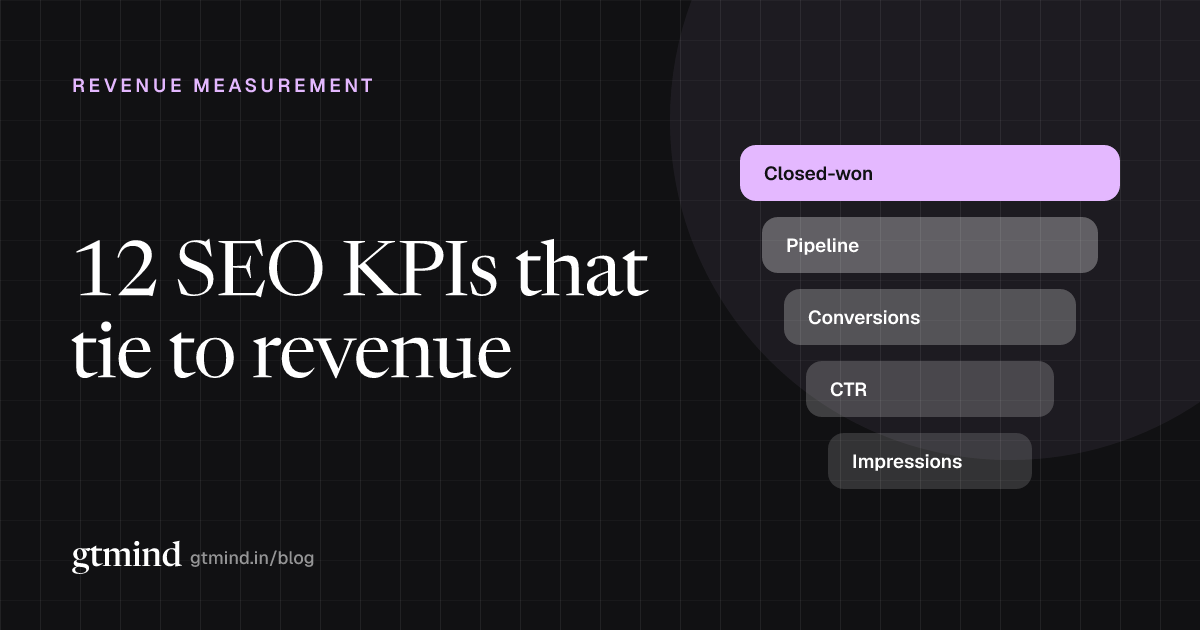
Revenue measurement
12 SEO KPIs That Actually Tie to Revenue
Most SEO KPI lists are flat. This one is a ladder: 12 metrics from impressions to closed-won, each with a formula, a data source, a target and a dashboard layout to report them.
9 min read
GTM & RevOps
What Is RevOps? Revenue Operations, Explained
RevOps runs marketing, sales and customer success off one process and one dataset. Here is what it does, how it differs from sales ops, who it reports to, and how AI is changing it.
9 min read