AI agents
AI Marketing Agents: What They Do, 10 Examples, and How to Choose One
What AI marketing agents actually do, 10 examples across SEO, content, pipeline and analytics, and the guardrails to demand before granting write access.
By the gtmind teamPublished 11 min read
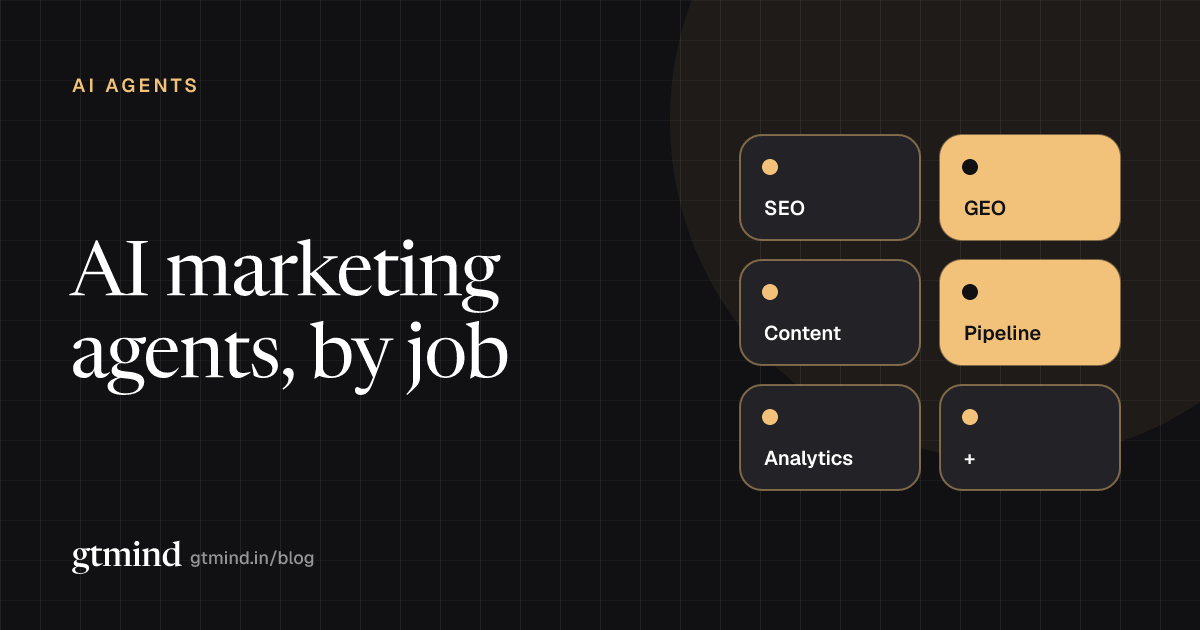
AI marketing agents are software that watch your marketing data, decide what to do next, carry out the work in your tools and then check whether it helped. Unlike a copilot, which waits for a prompt, an AI marketing agent runs on its own loop inside limits you set, such as "refresh pages that lost rankings, but ask before publishing."
Key takeaways
- An agent is defined by the loop it runs (read, decide, act, learn), not by the model inside it.
- Choose agents by the job you need done, not by vendor lists. Ten common jobs are below.
- The platform question comes second: native CRM agents, agent builders or DIY workflows each fit a different team.
- Demand four guardrails before giving any agent write access: read-only default, reversible edits, per-agent permissions and data isolation.
- Pricing is split between seats, org-level subscriptions and per-outcome credits. Check what counts as an "outcome."
What are AI marketing agents? Agent vs automation vs copilot
The word "agent" gets stuck on everything from chatbots to scheduled email sends. A practical test: does the software decide which action to take, based on data it reads, and then take it? If yes, it is an agent. If it only runs a fixed rule, it is automation. If it only responds when you ask, it is a copilot.
| Automation | Copilot | AI agent | |
|---|---|---|---|
| Starts when | A fixed trigger fires | You type a prompt | Its data changes or on a schedule |
| Decides what to do | No, follows a rule | You decide | Yes, within limits |
| Takes action in tools | Yes, one fixed action | Rarely | Yes, multi-step |
| Checks the result | No | No | Yes, should |
| Example | "Send email 2 days after signup" | "Write me a subject line" | "Find pages losing clicks, draft fixes, ask for approval" |
Most AI agents in digital marketing today are narrow. They own one job, like qualifying inbound leads or drafting a campaign. That is a feature, not a limitation. A narrow agent with clear permissions is far easier to trust than a general one with access to everything.
How an AI marketing agent works: read, decide, act, learn
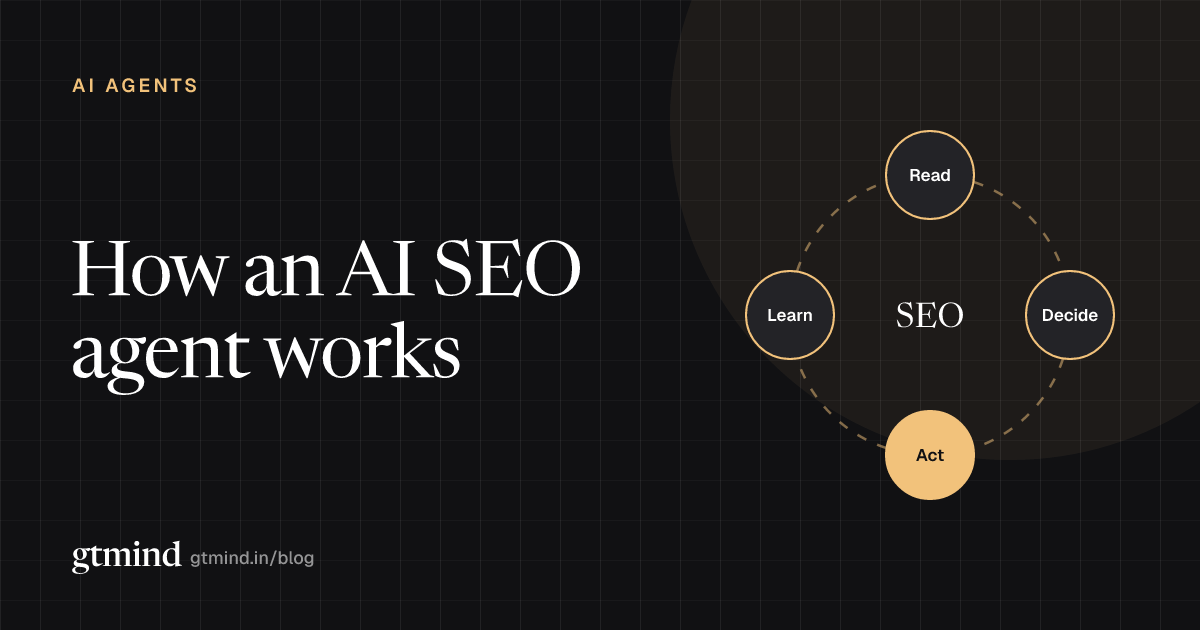
Every useful agent runs some version of the same four-step loop. The steps are simple; the quality of each one is where products differ.
1. Read
The agent pulls data from the systems that describe your market: Search Console for queries, GA4 for sessions, your CRM for deals, your CMS for what is published. The more of these it can join, the better its decisions. An agent that only sees email opens can only optimize email opens.
2. Decide
Next, it ranks what to do. Weak agents rank by generic best practice ("this page is missing an H2"). Strong ones rank by expected impact on your own numbers, for example "this page used to bring in demo requests and has dropped from position 4 to 11."
3. Act
Then it does the work: drafts the page, rewrites the metadata, adds internal links, builds the segment, pushes a task to the CRM. Good agents stage these changes for approval rather than pushing them live by default.
4. Learn
Finally, it checks whether the number moved, usually over weeks rather than hours, and feeds that back into how it scores the next round. This is the step most tools skip, and it is the one that separates an agent from a very fast intern.
This is the same loop gtmind is built around. You can see how the read, decide, act and learn steps work in gtmind, where every finding gets a revenue figure modelled on your own closed-won deals before any agent acts on it.
10 AI marketing agent examples, organized by job
Most "top AI marketing agents" lists are really lists of platforms, and most of those platforms are B2C email and CDP tools. It is more useful to start from the job. Here are ten jobs agents do well today, with what each one reads and does.
| # | Job | Reads | Does | Human approves? |
|---|---|---|---|---|
| 1 | SEO refresh | Search Console, CMS | Updates decaying pages | Yes, before publish |
| 2 | GEO / AI citations | AI answers, your pages | Writes content that gets cited | Yes |
| 3 | Content brief to publish | Search demand, CMS | Brief, draft, schema | Yes |
| 4 | Pipeline follow-up | Web visits, CRM | Pushes accounts to sales | Optional |
| 5 | Analytics anomaly | GA4, deploy log | Explains drops | No, alert only |
| 6 | Ad budget | Ad platforms, CRM | Shifts spend | Yes, above a limit |
| 7 | CRM, engagement | Personalizes flows | Yes, first sends | |
| 8 | Social | Content, trends | Drafts and schedules posts | Yes |
| 9 | Lead scoring | CRM, firmographics | Scores and routes leads | Spot checks |
| 10 | Competitor watch | Competitor sites, SERPs | Flags changes | No, alert only |
1. SEO refresh agent
Watches Search Console for pages whose clicks and positions are sliding, works out why (outdated facts, a new competitor, cannibalization) and drafts a refresh. It is the clearest agent use case in marketing because the data is structured and the result is measurable. We cover it in depth, including an n8n build, in our guide to the AI SEO agent.
2. GEO or AI-citation agent
Tracks whether ChatGPT, Gemini, Perplexity and Google AI Overviews mention you for the questions your buyers ask, then writes or restructures content so it is easier to cite. If this is new to you, start with our explainer on LLM SEO and getting cited by AI search.
3. Content brief-to-publish agent
Finds search demand with no page behind it, writes the brief, drafts the page, adds schema and hands it to an editor. The handoffs between SEO, writer and web team are where most content calendars stall, so this agent saves elapsed time more than writing time.
4. Pipeline follow-up agent
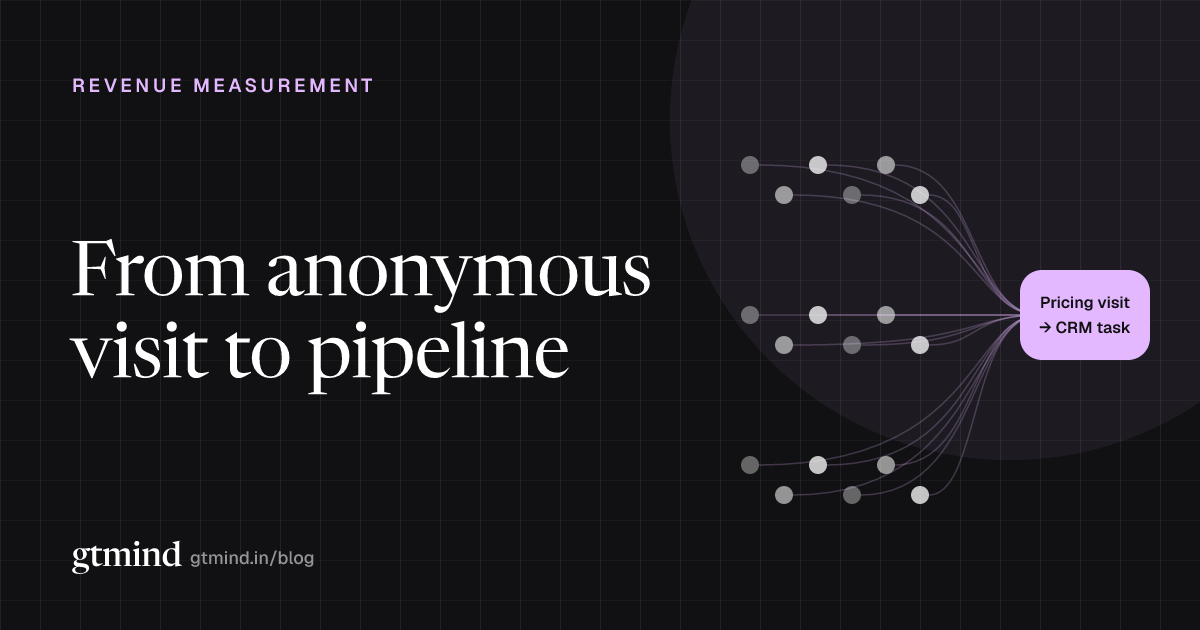
Spots high-intent behavior, such as a known account reading your pricing page three times in a week, and pushes that account to the CRM as a task or segment. It is one of the most practical AI agents for sales and marketing because it sits right on the handoff between the two. The data side of this is covered in our piece on website visitor tracking and buying signals.
5. Analytics anomaly agent
Watches traffic, conversion and deploys, and when something drops, it traces a likely cause ("the demo form stopped firing after Tuesday's release") before anyone asks. This one should almost never act on its own. Its job is to explain.
6. Ad budget agent
Moves spend between campaigns based on cost per opportunity rather than cost per click. The risk is real money, so set hard caps and require approval above them.
7. Email agent
Personalizes nurture flows per recipient: which content to send, when, and with what subject line. Salesforce and HubSpot both now sell agents for this, covered below.
8. Social agent
Turns one long piece into channel-native posts, drafts replies and schedules them. Useful for volume, but brand voice drifts quickly without a human editor.
9. Lead scoring agent
Scores and routes inbound leads using fit and behavior, and explains why each score was given. The explanation matters. A score nobody trusts gets ignored by sales.
10. Competitor watch agent
Monitors competitor pricing pages, new content and ranking changes, then flags what matters. Alerts only; the response is a human decision.
AI marketing agent platforms, by category
There are roughly four ways to get an AI marketing agent: native agents inside your CRM or marketing suite, agent-builder platforms, content-focused tools, and do-it-yourself workflows. The descriptions below come from each vendor's own site, checked in September 2026.
Native CRM and marketing-suite agents
Salesforce: Campaign Agent from Marketing Cloud. Salesforce describes Campaign Agent as selecting audiences, content variations, message types and send times toward a marketer-defined goal, and suppressing campaigns that should not be sent. Salesforce says it becomes generally available in Marketing Cloud Next Advanced by October 2026, with some limitations. Best fit: teams already running on Salesforce.
HubSpot: Breeze agents. HubSpot's Fall 2026 Spotlight lists a set of Breeze agents including Campaign Agent, Content Agent, Nurture Agent, Prospecting Agent and Customer Agent, plus Agent Builder for custom agents. Best fit: HubSpot-native teams that want agents working on CRM data they already have.
Agent-builder platforms
Relevance AI. Relevance AI positions itself as "the home of the AI Workforce" and lists marketing agents such as an MQL Qualifier, Lifecycle Marketer, Campaign Reporter and SEO Brief Writer. Best fit: teams that want configurable agents across several tools without writing code.
n8n. An open-source workflow tool with AI agent nodes. You design the loop yourself, which means full control and full responsibility. Best fit: technical marketers and GTM engineers.
Content and commerce tools with agents
Jasper. Jasper's pricing page advertises "100+ purpose-built marketing agents," with agents for core workflows on its Pro plan and a no-code builder for custom agents on Business.
Shopify Sidekick. For ecommerce, Shopify's Sidekick is an assistant that writes product copy, social posts and email campaigns inside the store admin. It is closer to a copilot than an autonomous agent, but it is where many small brands first meet AI in marketing.
Ahrefs Letaido. Ahrefs' Letaido is an agent workspace that reads Ahrefs data to build reports, run recurring research and monitor sites and competitors.
Where gtmind fits
gtmind is not a general agent builder or an email platform. It builds one model of your go-to-market from Search Console, GA4, your CRM and your published pages, ranks each opportunity by the revenue it is likely to bring, and runs a small set of SEO, GEO, content, pipeline and analytics agents on the plays you approve. If you mainly need email journeys or ad bidding, one of the tools above is a better fit.
| Category | Examples | Strength | Trade-off |
|---|---|---|---|
| Native suite agents | Salesforce, HubSpot | Already sees your CRM | Locked to one stack |
| Agent builders | Relevance AI, n8n | Flexible, cross-tool | You design the guardrails |
| Content tools | Jasper, Letaido | Fast output | Rarely tied to revenue |
| Revenue-scored agents | gtmind | Ranks work by pipeline | Narrower set of jobs |
Guardrails checklist: what to demand before giving an agent write access
This is the section most comparisons skip, and it is where agent projects fail. Gartner predicts over 40% of agentic AI projects will be canceled by the end of 2027, citing escalating costs, unclear business value and inadequate risk controls. Two of those three are governance problems.
Before any agent touches your site, CRM or ad account, check these four things.
Read-only by default
The agent should connect with read access first and prove it understands your data before it writes anything. Ask the vendor: "Which scopes do you request on day one?" If the answer includes write access to everything, walk away.
Every change is reversible
Agents should never delete. Each edit should be stored as a revision you can roll back in one click, with a log of what changed and why. Ask for a demo of the rollback, not just a description of it.
Permissions per agent, not per platform
An SEO agent needs to edit pages in your CMS. It does not need to edit CRM deals. Each agent should get only the scopes for its job, and you should be able to revoke them from the connected system itself.
Your data stays yours
Your records should build your model only. Confirm in writing that your data is not pooled with other customers or used to train models for anyone else.
These are the three principles gtmind itself runs on: read-only by default, every change reversible, and your data kept to your account. You can read the specifics on our data handling page.
A fifth, softer check: what is the agent scored on? If an agent reports "42 pages optimized" but cannot tell you whether any of them brought in pipeline, you are paying for activity. Ask how the vendor measures results, and over what time window.
How much do AI marketing agents cost?
AI marketing agent pricing falls into three models: per-org subscriptions, per-seat plans and per-outcome credits. Here is what vendors publish (as of September 2026).
| Product | Pricing model | Published price |
|---|---|---|
| Salesforce Marketing Cloud Next Growth | Per org, billed annually | $1,500/org/month |
| Salesforce Marketing Cloud Next Advanced | Per org, billed annually | $3,250/org/month, limited Campaign Agent use included |
| HubSpot Customer Agent | Per outcome | $0.50 per resolved conversation |
| HubSpot Prospecting Agent | Per outcome | $1 per lead recommended |
| Relevance AI | Enterprise | Pricing on request |
| Jasper Pro | Per seat | $69/seat/month, or $59 billed annually |
| Ahrefs Letaido | Subscription | From $99/month |
| Shopify Sidekick | Bundled | Included with Shopify plans |
| n8n | Executions | Cloud from €20/month billed annually; Community Edition free to self-host |
A few notes on reading these numbers:
- Outcome pricing is only as good as the definition of an outcome. HubSpot's per-outcome pricing for Customer Agent and Prospecting Agent took effect on April 14, 2026. Read how "resolved" or "recommended" is defined before you forecast spend.
- Additional agent usage is often extra. Salesforce says additional agentic campaigns and content generations will be available for an additional cost, without publishing that price.
- DIY is not free. A self-hosted n8n agent costs nothing in license fees, but you pay for model API calls, hosting and the engineering time to maintain it.
The better question than "how much does it cost" is "what is one completed job worth?" If a refreshed page recovers a ranking that used to produce two demo requests a month, the agent's cost per job is easy to compare. That calculation is what gtmind puts next to every play before an agent acts on it.
How to choose an AI marketing agent
A short decision path:
- Pick the job first. Use the ten jobs above. Start with one where the data is clean and the result is measurable, like SEO refresh or pipeline follow-up.
- Check what data the agent can read. An agent that cannot see your CRM cannot tell you which work drove revenue.
- Run the guardrails checklist. Read-only default, reversible edits, per-agent permissions, data isolation.
- Agree on the metric and the time window before you start. Ranking and pipeline effects usually take weeks.
- Start with approval on everything, then loosen it one action type at a time as the agent earns trust.
An illustrative example of the kind of play gtmind surfaces: a comparison page against your main competitor, scored at a projected $42K a month in pipeline with 89% confidence and medium effort. The content agent drafts the page, an editor approves it, internal links and schema are added, and the page is watched for six weeks to see whether the ranking and the pipeline actually moved. The figures are the sample shown on our homepage, not a customer result, but the shape is the point: one job, one number, one approval, one check.
Frequently asked questions
What can AI agents do for marketing?
AI agents can watch marketing data and act on it: refreshing pages that lose rankings, drafting content briefs, flagging traffic drops, scoring leads, pushing high-intent accounts to the CRM and building campaign drafts. The useful ones work on a loop of read, decide, act and learn, and they ask for approval before changing anything customers will see.
Which AI agent is best for marketing?
There is no single best one. Pick by job and by stack. If you run on HubSpot or Salesforce, their native agents see your CRM with the least setup. If you need custom workflows across tools, an agent builder like Relevance AI or n8n fits better. Judge any option on permissions, reversibility and whether it measures results in revenue.
How much do AI agents cost?
Prices vary by model. As of September 2026, HubSpot charges per outcome, such as $0.50 per resolved Customer Agent conversation. Salesforce bundles limited Campaign Agent use into Marketing Cloud Next Advanced at $3,250 per org per month. Jasper starts at $69 per seat per month. Builders like n8n can be self-hosted for free, plus model and hosting costs.
Can I hire an AI agent?
Not in the employment sense, but you can buy or build one for a defined job. Most vendors sell agents as part of a platform subscription or pay-per-outcome credits. Treat it like a new hire on probation: give it one clear job, read-only access first, a human approver for anything it publishes, and a metric it is judged on.
Keep reading
AI agents
AI SEO Agents: How They Work and What They Should (and Shouldn't) Do
An AI SEO agent turns Search Console data into shipped fixes. How the loop works, six use cases, a minimal n8n build with human approval, and what to check before you buy.
10 min read
AI search
LLM SEO: How to Get Your Brand Cited in AI Answers
LLM SEO gets your pages cited in ChatGPT, Gemini, Perplexity and AI Overviews. A five-step playbook, from crawler access to tying citations to pipeline.
13 min read
Revenue measurement
Website Visitor Tracking for B2B: From Anonymous Visit to Pipeline
Most B2B visitors never fill in a form. Here is how visitor tracking and identification work, what match rates to expect, the privacy rules, and how to turn a pricing visit into a follow-up.
9 min read